
72 hr
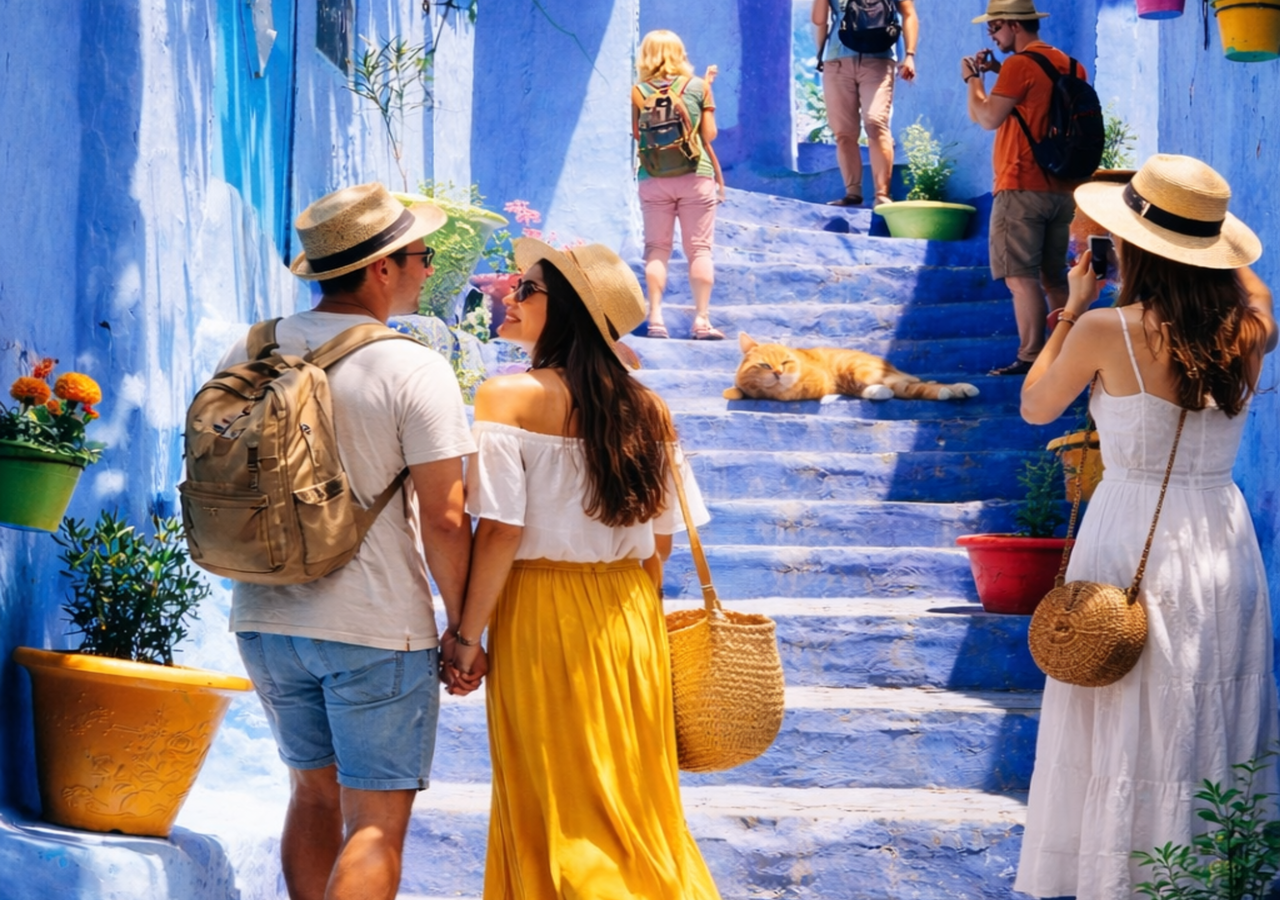
3-Day Imperial Cities Tour from Marrakech
Journey through Morocco's legendary cities, from Fez's ancient medina to Chefchaouen's blue streets
Reserve
Hand-picked by our editors — only the best 5 experiences from 12 reviewed.
Verified partners for every tour, free cancellation where available, and instant confirmation on every booking.
72 hr
Journey through Morocco's legendary cities, from Fez's ancient medina to Chefchaouen's blue streets
Reserve
6 hr
Discover Morocco's capital with a guided exploration of historic monuments and medieval quarters
Reserve
6 hr
Explore Morocco's capital city with visits to historic monuments, a scenic kasbah, and insights into royal heritage
ReservePrices from verified partners. Availability updates in real time at checkout. Free cancellation policies apply where shown.
The landmarks, rooms, and views travelers on this tour remember — all visible on a single visit.
A masterpiece of Sicilian-Norman architecture with striking marble floors. It was rebuilt in the 17th century after an earthquake.
This imposing Baroque structure serves as the main city gate entrance. It was built by Grand Master Vilhena in 1726.
These walls offer views across half of Malta. The vantage point is especially popular during a mdina evening tour.
Located on the ramparts, this spot is famous for cake and horizon views. It provides a rest stop during your mdina evening tour.
These subterranean tunnels reveal the dark history of the city. They feature life-sized dioramas within the historic walls.
Professional guides provide historical context for the Silent City, while self-guided walks offer personal freedom; visitors who prioritize deep local insight prefer the guided mdina evening tour experience.
| Feature | Top pick Guided Tour | Self-Guided |
|---|---|---|
Narrative Depth |
Expert-led storytelling | Personal discovery |
Flexibility |
Fixed schedule | Full autonomy |
Group Interaction |
Shared social experience | Independent travel |
Cost Efficiency |
Paid ticket required | 0 EUR (summer) |
Pacing |
Structured timeframe | At visitor discretion |
Logistics |
Organized by operator | Managed by individual |
| See tickets → |
Verdict: Opt for mdina evening tour tickets if you value curated historical narratives, or choose independent wandering to customize your evening among the limestone landmarks at your own pace.
Choose your ticket, select your date, and reserve in under two minutes. Secure checkout handled by our verified partner.
Instant confirmation by email, with a mobile voucher you can save offline. No printing, no queuing at a collection desk.
Arrive at the entrance, show your voucher on your phone, and walk in. Most tickets include priority or skip-the-line access.
Practical details for your visit straight from our verified partners — hours, access, rules, and how to get there.
Mdina, Malta
Look for the bridge entrance
Buses from Valletta stop near the Main Gate.
Direct drop-off at the city entrance.
Modest clothing is requested if you plan to enter the cathedral or chapels. Shoulders and knees should be covered.
Standard backpacks are permitted. Large luggage is discouraged due to the narrow, historic alleyways.
Photography is permitted in public squares and streets during your mdina evening tour. Private residences and certain religious interiors may restrict flash usage.
The city features steep limestone inclines and ancient cobblestones. Wear sturdy footwear for your Mdina and Rabat walk.
Mobile phone use is permitted throughout the city. Keep volumes low to respect the quiet atmosphere.
The silent city is suitable for families. Strollers may be difficult to navigate on historic pavement.
Several cafes are located near the Main Gate. Local pastries like pastizzi are popular in nearby Rabat.
Small dogs are permitted on leash in public areas. Keep pets away from religious monuments.
The Mdina evening tour offers a unique look at the Maltese history. Remain on public pathways.
Best time to go, insider tips, nearby landmarks, and the cancellation fine print — flip through to skim what matters to you.
How crowds, weather, and events shift across the year.
Evenings are vital to escape the day heat. Temperatures settle after 18:00.
Mild weather is perfect for walking. Enjoy the blooming flora on the bastions.
Fewer crowds and comfortable nights. Ideal for photography enthusiasts.
Cool and breezy. Bring a layer as the limestone walls retain cold.
Small details that turn a good visit into a great one.
Maintain a low voice level as it is known as the Silent City. This enhances the mdina evening tour experience.
Avoid flash when capturing interior stone work. It preserves the historic paint.
Secure your mdina evening tour tickets in advance. This ensures availability during peak summer weeks.
Prioritize flats or sneakers. The stone is slippery in damp weather.
Reserve tables early for dinner. Most restaurants fill up during the mdina evening tour peak.
Access the city via the main bridge. This is the historic Mdina evening tour starting point.
Non-bookable sights within a short walk — free to visit, easy to pair.
Underground burial sites in Rabat
Ruins of a Roman townhouse
Green space between Rabat and Mdina
Historic catacombs and museum
Flexible, no hidden fees.
Full refunds are available for cancellations made at least 24 hours in advance. Please note that the streets have 0 EUR entrance fee.
Hand-picked options within walking distance — pick a district for vibe, or a specific hotel for convenience.
Historic boutique hotel in the city
Guesthouse with bastion views
Budget to mid-range options in Rabat
Mdina's fortified perimeter has enclosed fewer than 300 residents since the Knights of St. John relocated Malta's administrative seat to Valletta in 1571. The walled city occupies a limestone plateau 190 metres above sea level, its bastions and demi-lunes engineered by Italian military architects between 1530 and 1670. Bronze Age pottery shards unearthed beneath Villegaignon Street confirm human settlement dating to 700 BCE, though Mdina's defining silhouette—baroque palazzos pressed against Arab-Norman foundations—belongs to the seventeenth and eighteenth centuries. The Silent City earns its nickname after 18:00, when tour coaches depart and Mdina's narrow lanes empty. Evening light sculpts the honey-toned limestone facades lining Triq Villegaignon and Bastion Square, casting shadows that emphasise the shallow relief of coats-of-arms and baroque cornices. The Main Gate, rebuilt in 1724 under Grand Master António Manoel de Vilhena, frames views across terraced fields toward Mosta's dome and the Mediterranean horizon. St. Paul's Cathedral anchors the civic centre, its Latin-cross interior designed by Maltese architect Lorenzo Gafà and completed in 1702. The cathedral museum holds Dürer engravings and a polychrome wooden altarpiece dated 1520. Mdina's defensive works include ten demi-bastions and a dry moat encircling the plateau's western and southern flanks. The Greeks' Gate, Mdina's second entrance, pierces the eastern rampart and offers direct pedestrian access to Rabat, the extramural suburb that absorbed Mdina's Roman-era footprint. Archaeological evidence beneath Howard Gardens in Rabat reveals insulae and mosaic floors from the Roman municipium known as Melite. The Domus Romana museum, 200 metres beyond the Greeks' Gate, displays peristyle columns and polychrome tesserae recovered from a first-century CE villa. Evening tours navigate the city's principal streets—Triq Villegaignon, Triq San Pawl, Bastion Street—and pause at vantage points along the bastions. The fortifications command views across central Malta, with Valletta's Grand Harbour visible 12 kilometres east on clear evenings. Palazzo Falson, a thirteenth-century residence with Norman foundations, opens to visitors by appointment and houses a private collection of Maltese silver and maritime paintings. Mdina's street grid follows the irregular contours of the plateau, producing abrupt turns and enclosed courtyards that obscure sightlines and create microclimates within the walls. Temperature within the city drops noticeably after sunset, a function of thermal mass and reduced solar gain on the limestone surfaces.
"Mdina's bastions command views across central Malta, with Valletta's Grand Harbour visible 12 kilometres east on clear evenings."
A step-by-step walkthrough of the visit — what you'll see, how long each stage takes, and the details that matter.
You approach Mdina Main Gate as the sun drops toward the western horizon, its amber light warming the limestone bridge that spans the dry moat. Beyond the gate tunnel, Triq Villegaignon opens onto a corridor of baroque facades, their balconies and carved doorways aligned in tight succession. You walk the central axis toward St. Paul's Cathedral, passing Palazzo Costanzo and Palazzo Gatto Murina, their coats-of-arms legible in the low-angle light. At Bastion Square, you pause at the stone balustrade and scan the valley below—terraced fields, scattered farmhouses, Mosta's dome centred on the northern skyline. The rampart walk leads south along Magazino Curtain, where arrow slits and gun embrasures interrupt the parapet at regular intervals. You descend via a narrow alley to the Greeks' Gate, its smaller arch framing views of Rabat's rooftops and the parish church of St. Paul. Returning through the city's interior lanes, you pass shuttered palazzos and iron lanterns fixed to corner walls. The stone underfoot is polished smooth by centuries of foot traffic, its surface reflecting the warm glow of streetlamps that come on as dusk deepens. At the cathedral forecourt, you look back toward the Main Gate, now silhouetted against the fading western sky, and register the near-absence of ambient sound—no engine noise, no commercial activity, only the occasional footstep echoing off limestone walls.
The city streets are open 00:00–23:59. Individual landmarks have their own hours.
There is 0 EUR entrance fee to enter the city streets. Some museums charge separate fees.
Advanced mdina evening tour tickets are recommended for guided experiences. Check the operator inventory.
The medieval infrastructure is difficult for wheelchairs. Cobblestones and inclines are prevalent.
Arrival between 18:00–23:59 is ideal for your mdina evening tour. This avoids day crowds.
Photography is fine, but drones are prohibited in this historic site.
Modest dress is required for entering the cathedral. Keep shoulders and knees covered.
Yes, several restaurants operate within the walls. Many are open late during the mdina evening tour.
Yes, Rabat sites like the catacombs are nearby. Combine them before your mdina evening tour begins.